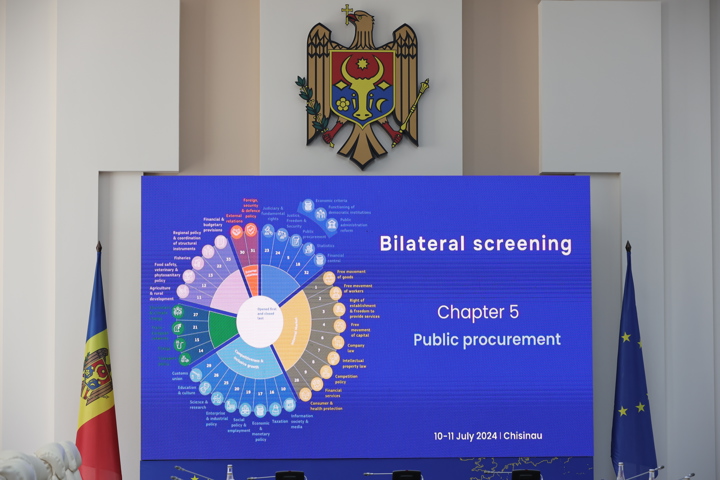
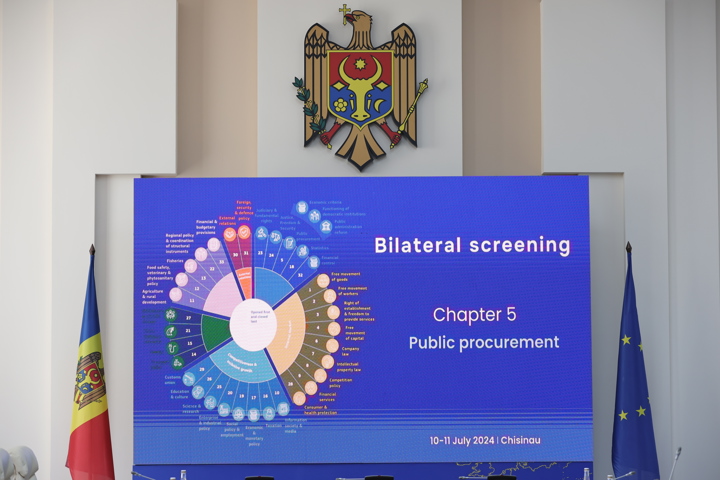
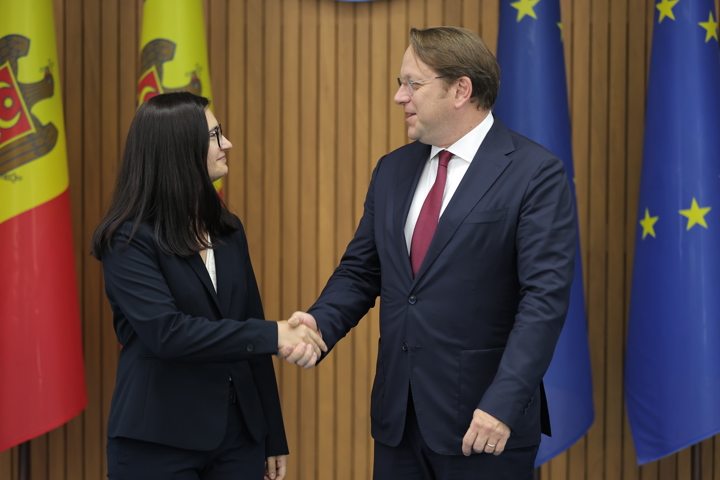
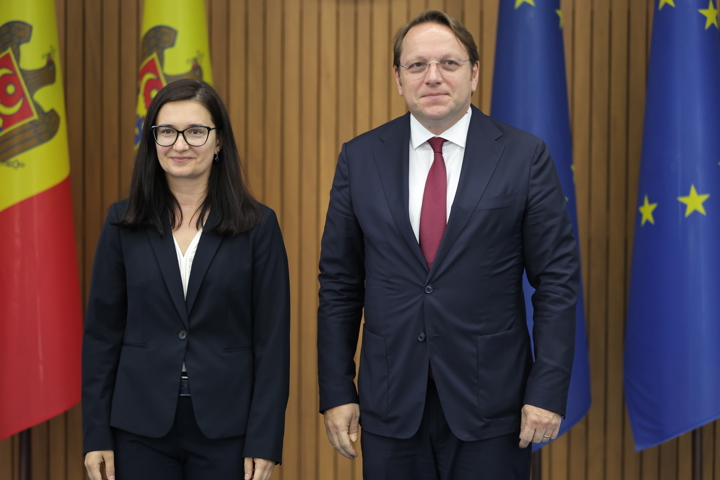
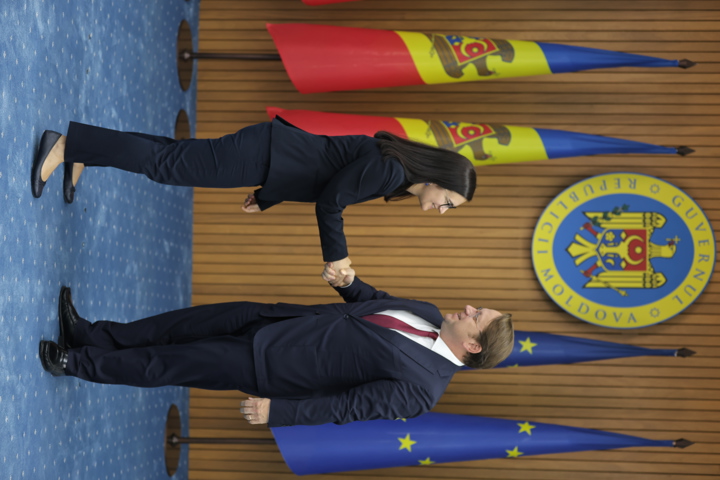
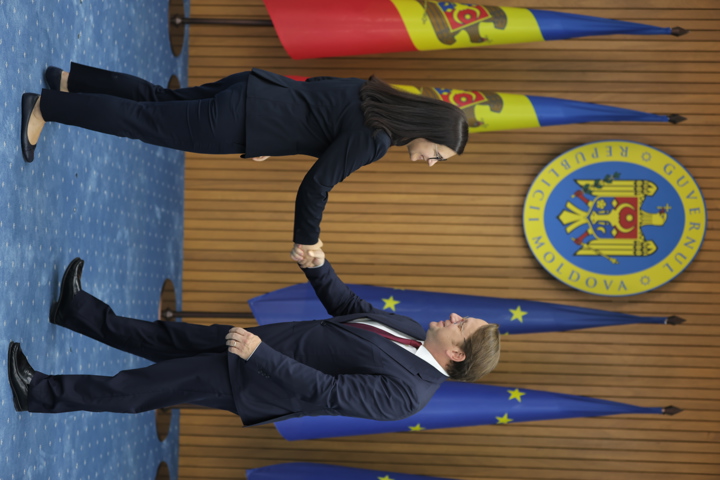
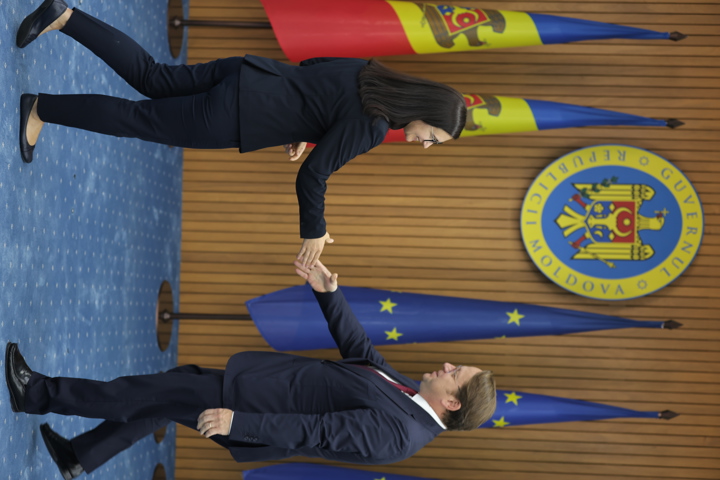
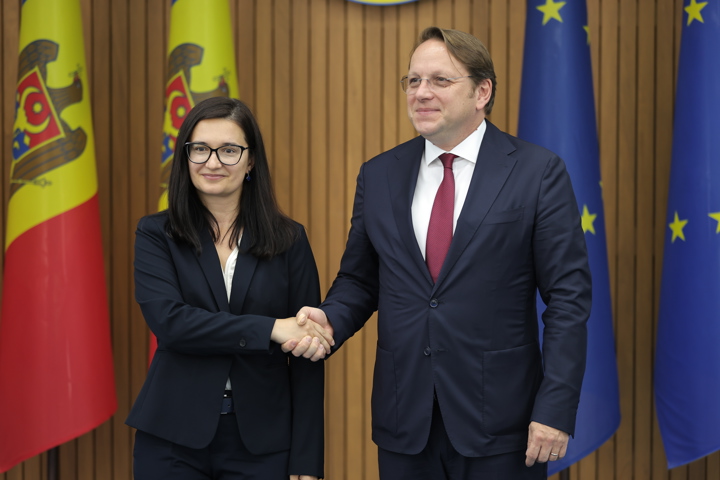
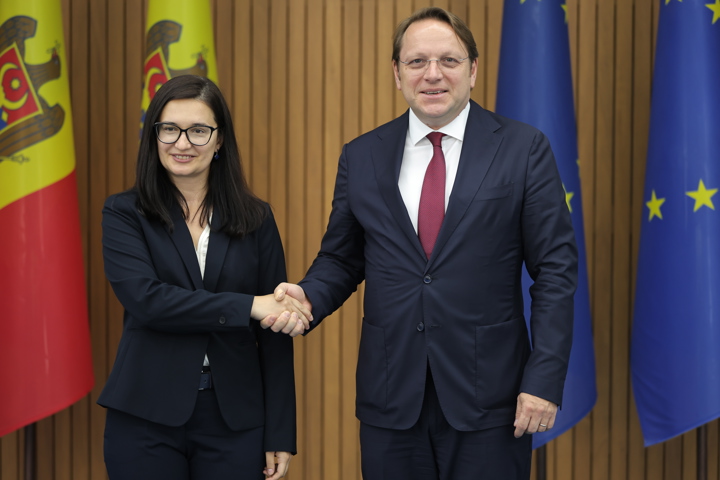
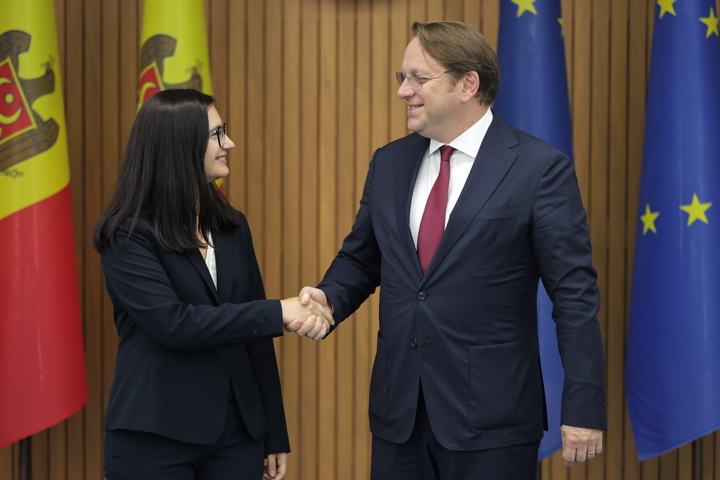
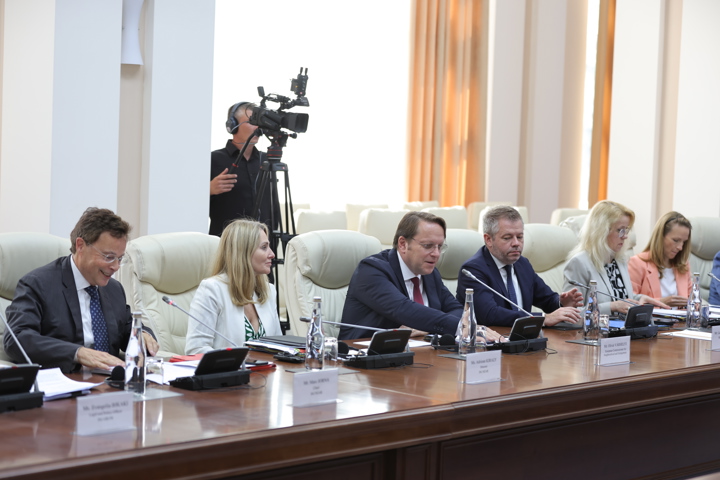
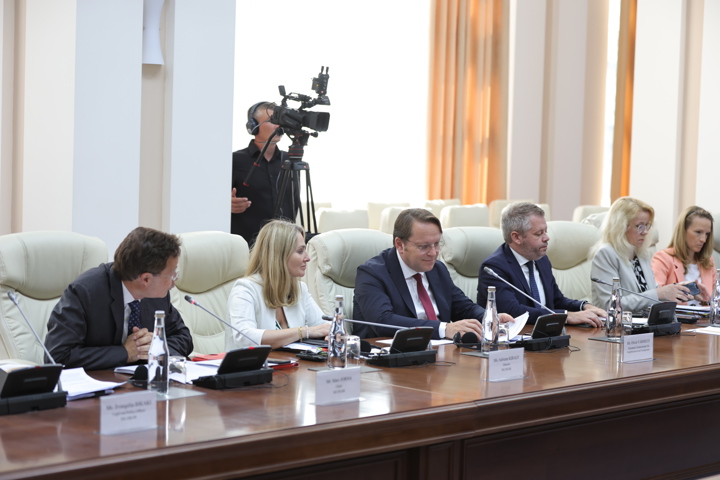
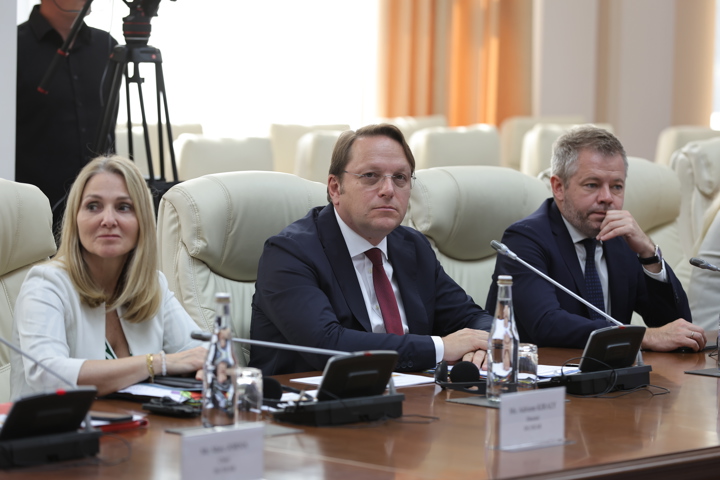
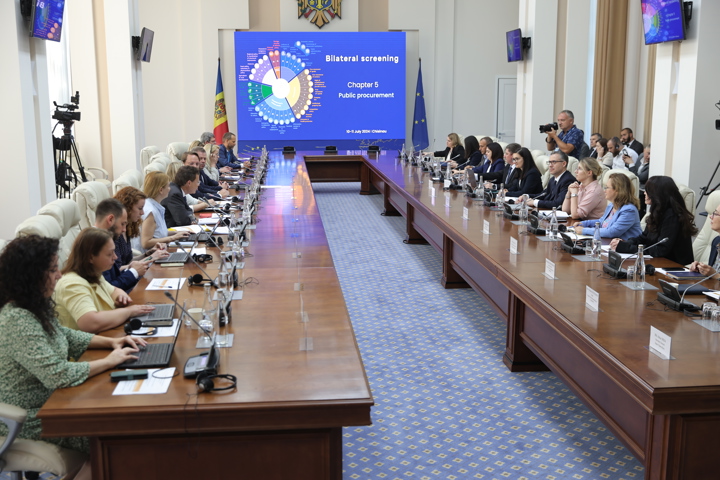
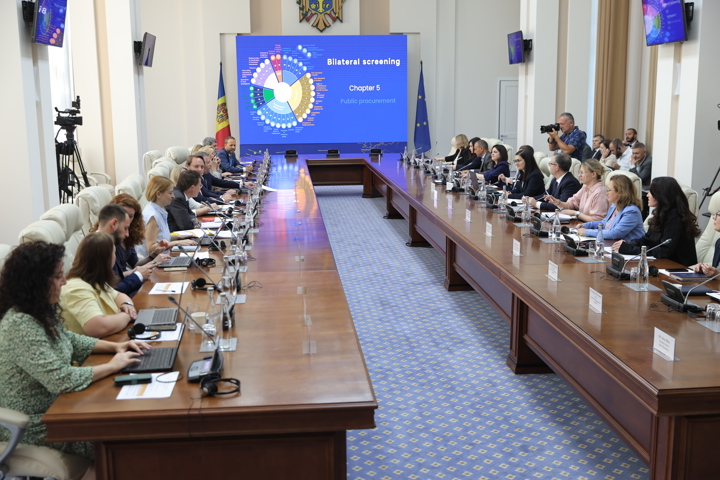
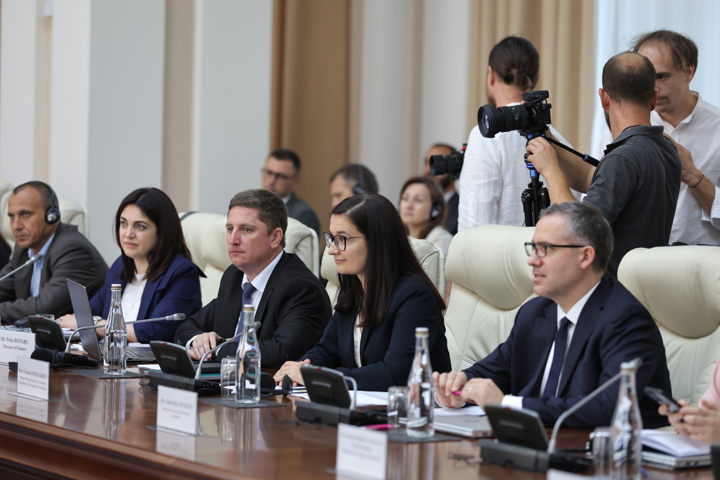
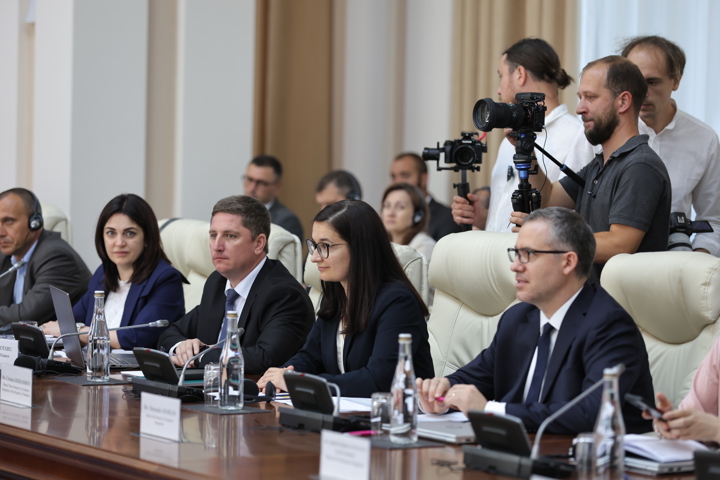
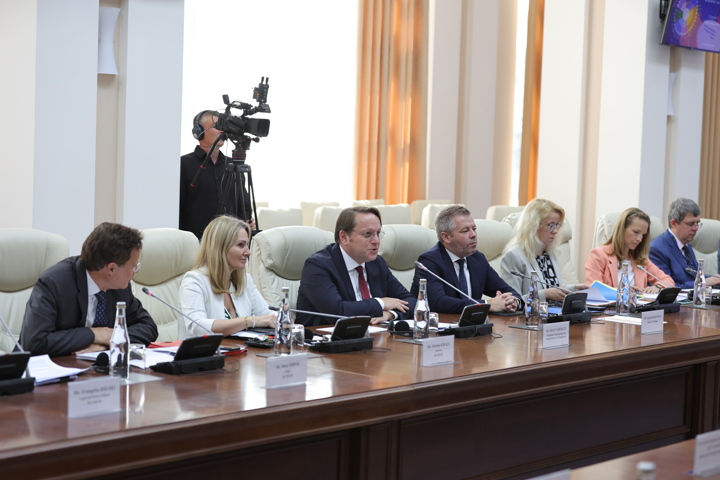
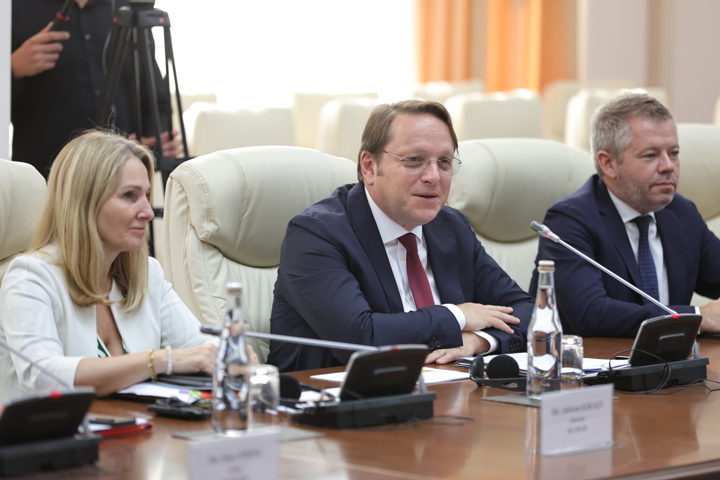
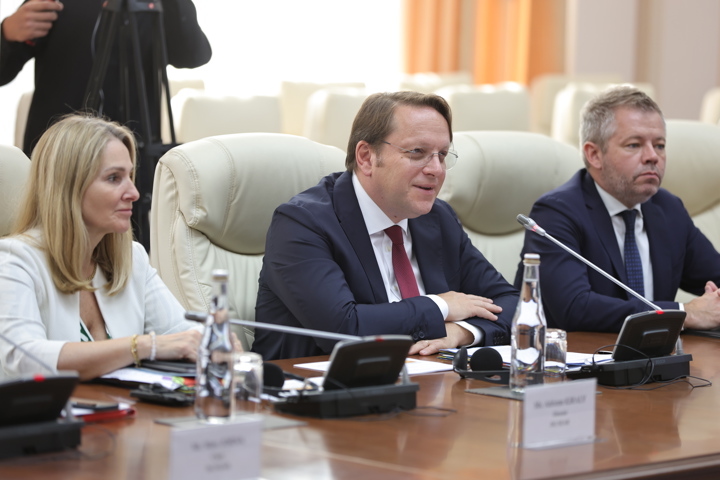
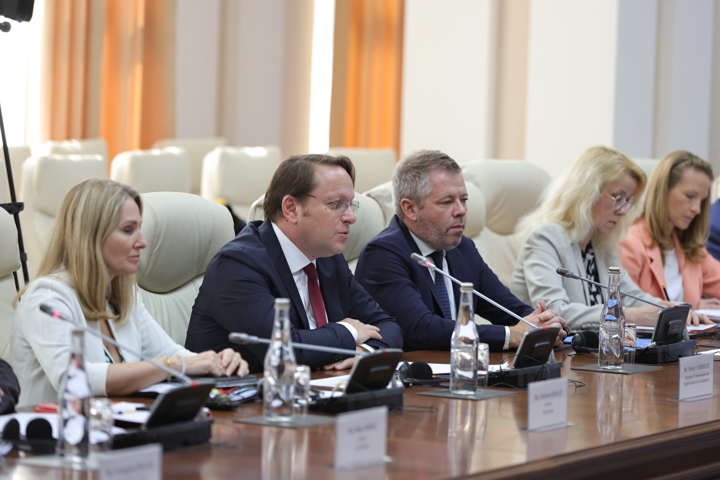
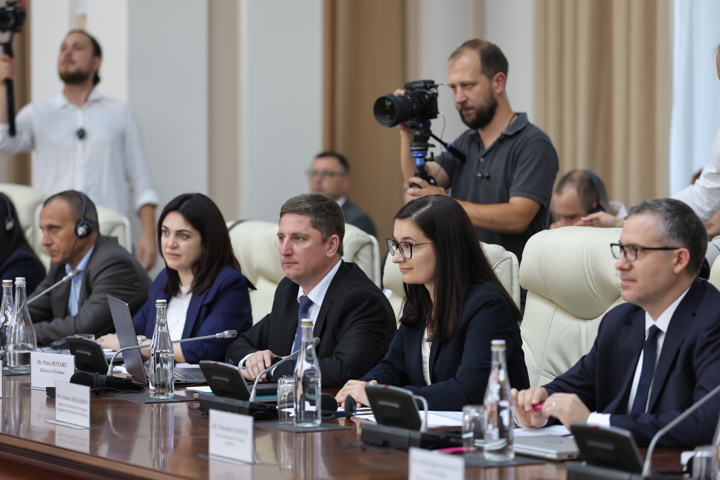
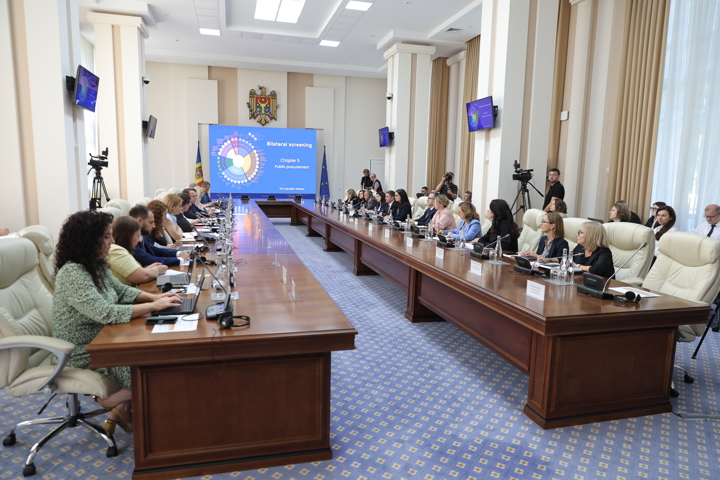
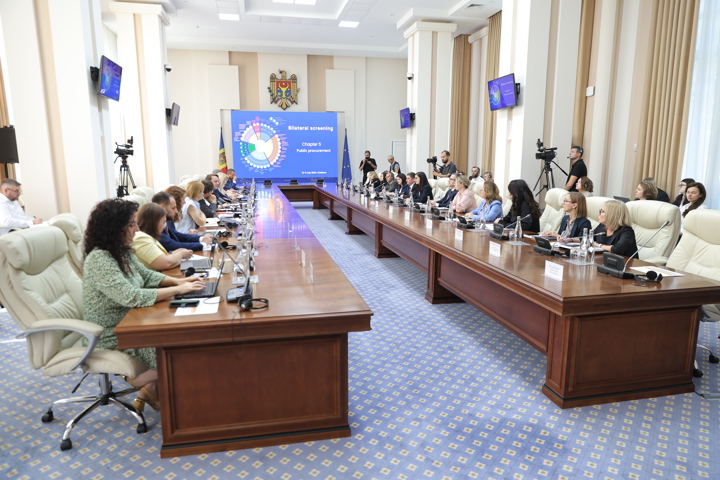
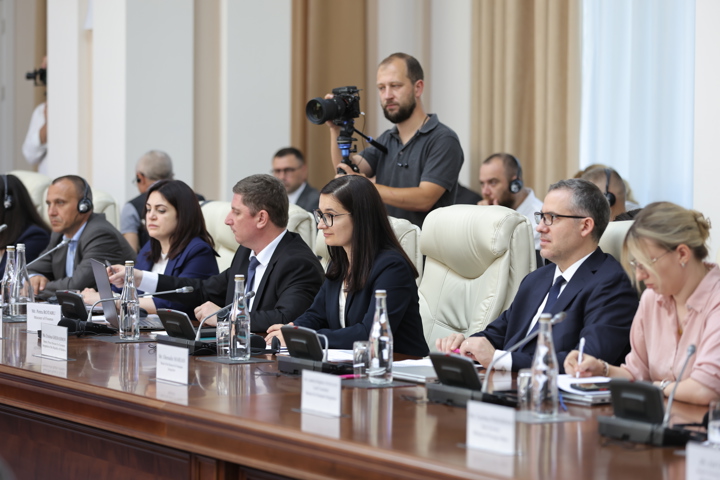
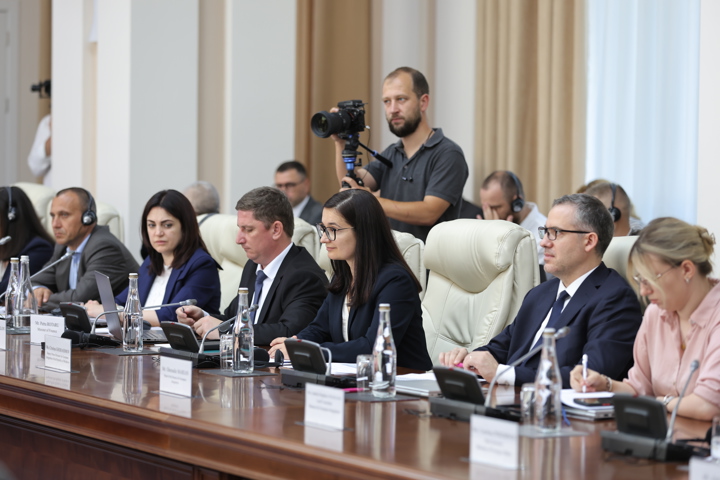
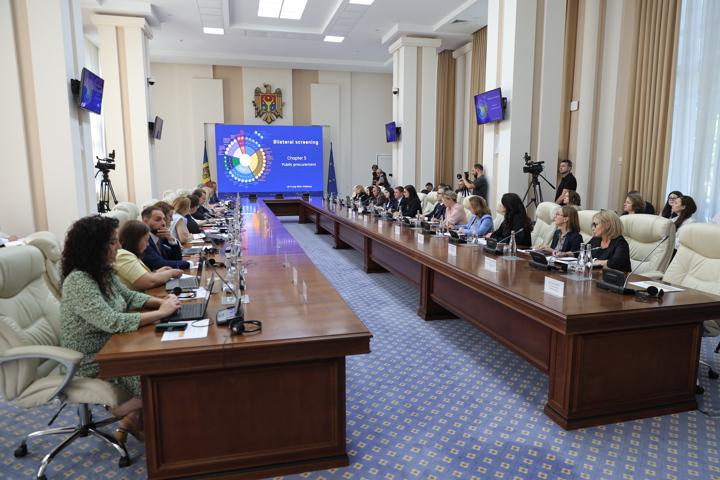
Your colleagues following us online with with the meeting in Brussels, but we are very happy to have the kickoff meeting of the bilateral screenings here in Chișinău on an important chapter chapter 5 public procurement.
Before I pass the floor to our commissioner, I would just want to make a few organizational remarks. And the first one is that in the explanatory meetings which we had, we were doing the talking and you were putting the questions.
This time around, it will be the reverse. You will be doing most of the talking and we will be asking the questions regarding your alignment with the acquis and regarding your implementation capacity.
We start these meetings always with two questions. The first question is whether you accept the acquis or whether you would be asking for transitional arrangements.
The second one is about accelerated integration. You will have seen that in the negotiating mandate there is the possibility of accelerated integration already before accession.
And the bilateral meetings are the moment also to make these requests. I would have to add that the fact that you ask for it does not automatically mean that you get it, but we will study it and then come back.
We have interpreters here with us, so you can speak your own language. I leave it at this for the organizational remarks and pass the floor to our commissioner. Commissioner, you have the floor.
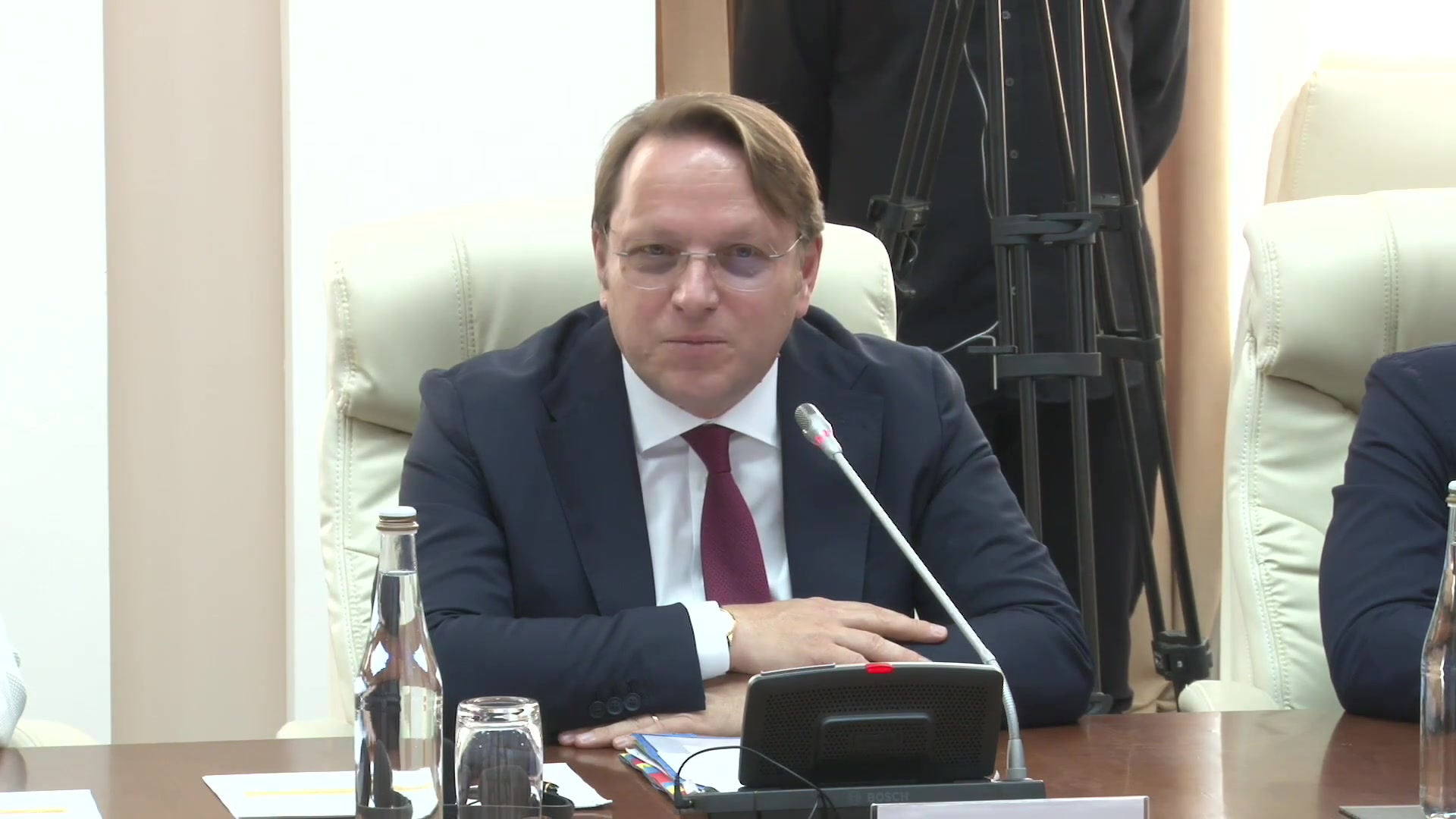
Thank you. Thank you very much.
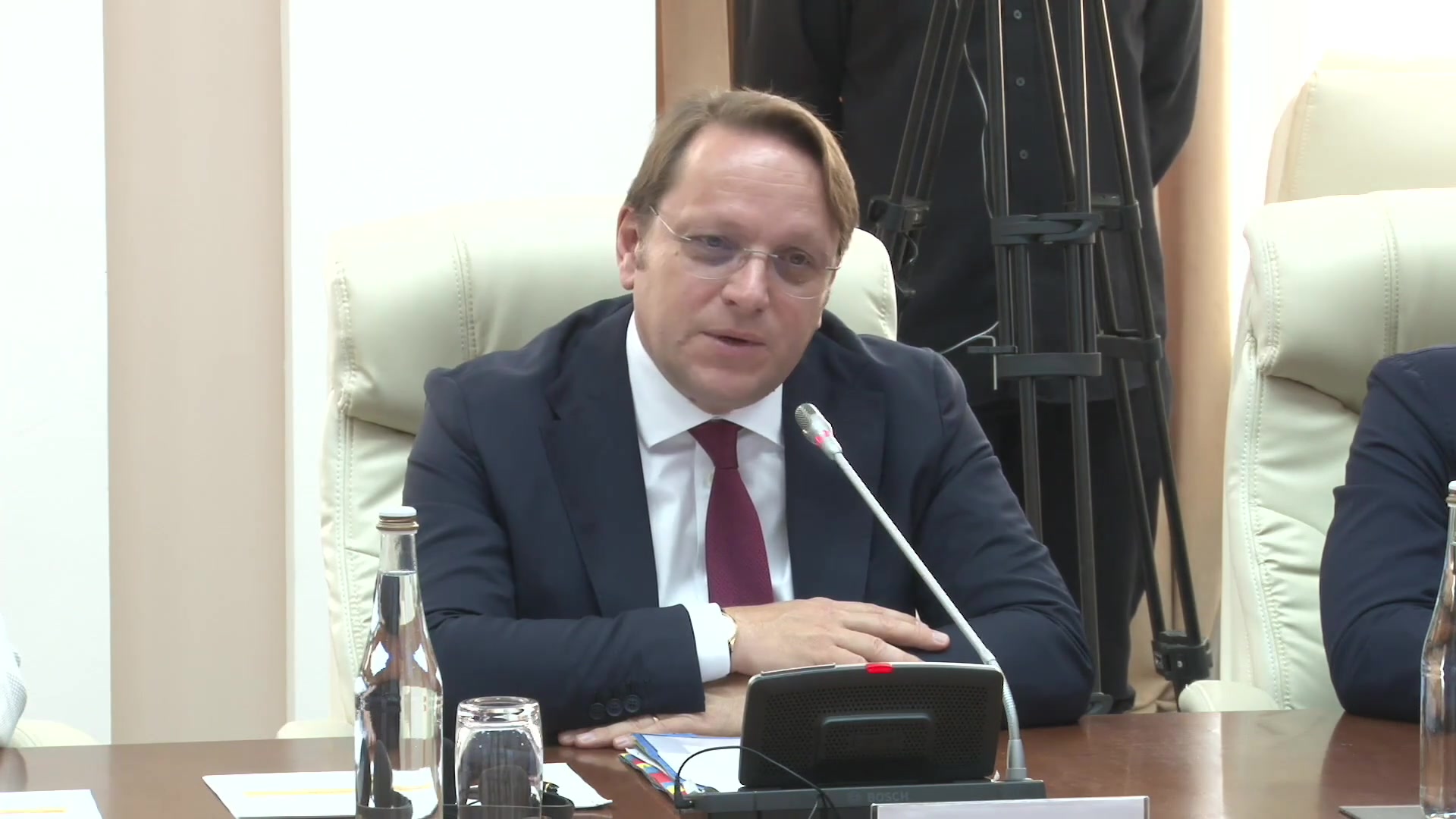
I'm very happy to be here and I'm very happy that we could combine this visit with the first screening of the accession negotiations with you.
It's been only a couple of weeks ago that we met in Luxembourg, where the first intergovernmental conference was organized. And I think that we have not lost any moment or second even to follow that up and start the the work immediately because, as you know, the whole accession negotiations start with the screening exercise.
And as bureaucratic and administrative it might sound, this is the bedrock of the accession negotiations themselves. Because this is the process through which you will get to see the entirety of all the conditions that you will have to meet to become a member state.
And this is also serving us the basics of understanding when and how Moldova could develop itself to be a member state. And this is much more than just comparing legislation. This is much more than just going through administrative details. This is also about building up institutions that are capable of enforcing all the rules that are to be transposed.
And I think since Moldova's application for for membership back in 2022, you have already moved a long way and you have acquired quite some speed and has shown a very strong commitment and determination.
However, that has only been the beginning. The hard work will only start now.
And this is why I want to, of course, commend you for all the all the work and the reforms that you have done. I have just seen the Speaker of the Parliament and also the opposition. I also thank them because it is not only the government that has delivered, but also the Parliament has delivered on many, many reforms that have been long outstanding, especially when it comes to the rule of law area.
In its critical issues like the reform of the judiciary, the fight against corruption, and these were very important to achieve the start of the accession negotiations.
So I think that with this in mind and also not forgetting about the broader geopolitical and political context, namely the pressure from Russia that you are subjected to, be it through blackmailing you through your energy system and vulnerabilities, the cyberattacks, the illicit cash flows, you name it. I think today my list only got longer.
You are standing firm and, of course, we are also standing firm in supporting you. And this is why I think it is extremely important that we pick up this work immediately.
My colleagues have told me that we have 1,200 Commission experts with over 4,000 highly relevant questions that have you have been addressed. And we you have 150,000 pages of EU acquis to go through.
But this is, of course, extremely important for the process to go forward. But it is equally important to talk about the benefits this will bring directly to the citizens. My colleague, Mr. Jorna, already mentioned the gradual integration. This is something which is a novelty which we will be able to do in parallel to the screening exercise.
But the screening exercise is also going to be critical because it is through the screening exercise that we can see which are the areas that you are capable of delivering full compliance with our rules and enforcement of our rules so that you can already enjoy the benefits of the single market in in areas where you are able to deliver earlier.
Because, of course, gradual integration means, and this is the flip side of the coin, that if you want to make use of it, you will have to comply fully even before accession of the criteria under EU law.
The other big topic I think that you will have to address in these talks is how you're going to be able to enforce these rules. So administrative capacity building is going to be an even more important topic because it's not only the rules that are necessary to be taken over, but also that they need to be fully enforced.
And that brings me to the to the topic of today because it seems that you are starting with public procurement. Chapter 5 that brings back some memories to me because when I started my career in the Hungarian state administration in 1996, that was one of my chapters.
So I know the feeling. I started exactly the same way. I was in the multilateral screening and in the bilateral screening. I was participating in in the revision of the Hungarian public procurement rules back then.
So I know I know the feeling. But public procurement, for example, is is not only important because this is part and parcel of the fundamental cluster, which is the rule of law area, as you know.
And with which any opening of negotiations on clusters will start with Moldova, but this would be the last cluster to be closed because this is going to be an overarching theme throughout the accession negotiations. Meaning that your general progress in the accession negotiations is going to be very much based on your progress on the fundamentals cluster.
So you can you have to make progress in the fundamental clusters to be able to make progress also in the sectorial. So public procurement in that regard is is going to be extremely important.
But the transparency, the fairness, and the value for money principle that it brings should also bring you probably access to European public procurement markets as you apply the same rules.
And these rules are also going to be tremendously important when it comes to the implementation of the Economic and Investment Plan and the growth plan that we will discuss later with with your president, prime minister, and also with you, Deputy Prime Minister.
So, as you apply public procurement rules of the European Union, it means that you can bring EU funds closer and faster to Moldova.
So, without any further ado, I don't want to prolong this part of the meeting because I know that you are busy. I just want to I just want to tell you that you are embarking on a on a very unique experience, I know, I was there.
And this should also bring you a transformation on the ground. So not only don't take it as just a mere administrative process, but also use it as a springboard for continuing the change and for accelerating the change so that your people can enjoy the benefits of the European Union, maybe even before enlargement. Thank you.
Thank you very much, Commissioner, for your welcoming words and for sharing your own experience in on the on the screening. We have a dedicated director general for this part of the acquis, which is called DG GROW.
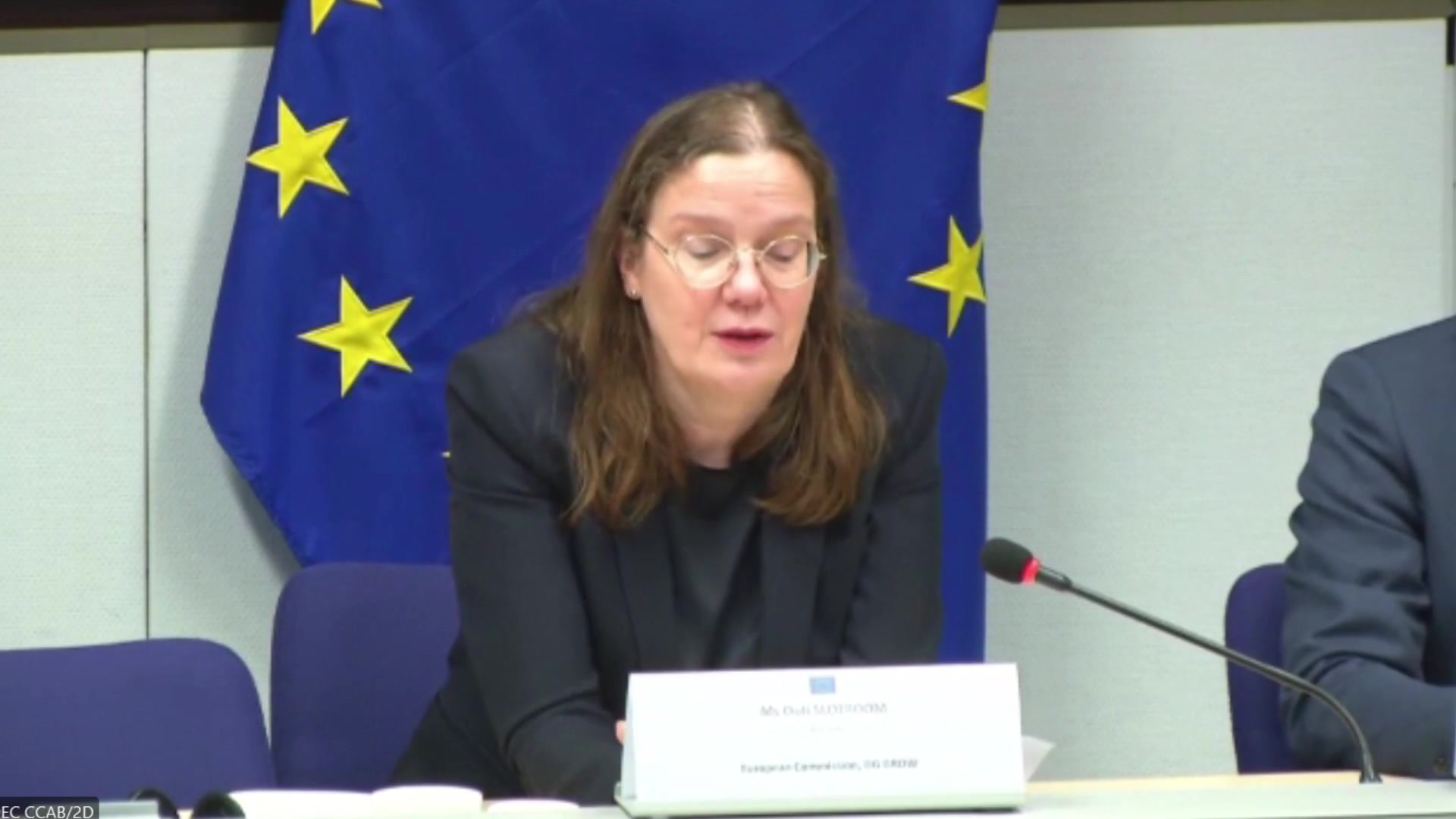
And we have online Outi Slotboom, director in DG GROW. So I would like to pass the floor to to Outi.
Can we get Outi on the screen?
Good morning, everybody. I hope that you can see me. Chișinău, good morning. Dear Deputy Prime Minister, Commissioner, dear all.
Even though we are online here in Brussels, it is an honor to witness the opening of the first bilateral screening meeting with Moldova dedicated to public procurement, a very appropriate area to start with.
Indeed, the Directorate-General that I represent, the Directorate-General for Internal Market, Industry, Entrepreneurship and SMEs, is, among the different Commission services, the one which is responsible for public procurement.
We also will work with you on four other chapters: on the free movement of goods, on the right of establishment and freedom to provide services, on intellectual property rights, and on enterprise and industrial policy. You have already been working actively with our experts and this work will continue. Today is one important step in that process.
Moldova today is a candidate country. The European Council has decided to open accession negotiations.
And also, on my behalf, I would like to sincerely congratulate you on that big step. But, of course, talking about public procurement, there has been progress. There has already been close cooperation between the Commission and Moldova under the Deep and Comprehensive Free Trade Area.
This has laid the foundation for closer economic integration between the EU and Moldova already, and this is a very good starting point for the screening exercise that we are opening today.
As the Commissioner said, public procurement is one of the fundamentals. This is a starting point and will be one of the endpoints of your negotiations.
Within the EU today, EU of 27, public procurement represents 14% of total gross domestic product. This is a very important area of the economy.
Running your public procurement policies in the best possible way means more value for public money, but also a method to make the economy more innovative, more sustainable, more competitive, and more inclusive.
In March, we had an update session on the EU public procurement acquis. I hope that this has been useful for you.
And, as Marc said, now we are turning the page and it is our turn to ask questions. In any case, I would already like to thank you for all the answers and replies you have provided up to now to all our questions.
The objective of the meeting today is indeed to go through your existing and planned legal alignment with the EU acquis in the area of public procurement.
We have the experts there with you in the room who know the EU rules and who are the ones you will be talking to.
But, as the Commissioner said, the EU acquis is one thing and enforcement is another equally important part. So the discussions which are starting now will also put a lot of focus on how you plan to implement the EU rules and on your administrative capacity.
I would like to make three remarks to conclude. First, again stress the general principles of which any good public procurement system should be designed: transparency, equal treatment, non-discrimination, and competition.
Secondly, I would again like to emphasize the importance of strong national institutions for the implementation of the public procurement rules. Particular emphasis should be put on the tools which are available to fight corruption in public procurement.
And finally, taking full advantage of digital solutions can be a critical element to enhance transparency and access to public procurement. And we believe that this is one of the areas where further efforts would be required.
I am very confident that the meeting which is starting now will be useful for both sides and wish you a very fruitful screening exercise.
Thank you very much, Outi, for the welcoming words on your side and for recalling the three main principles of public procurement.
Cristina, can I pass the floor to you for Moldova?
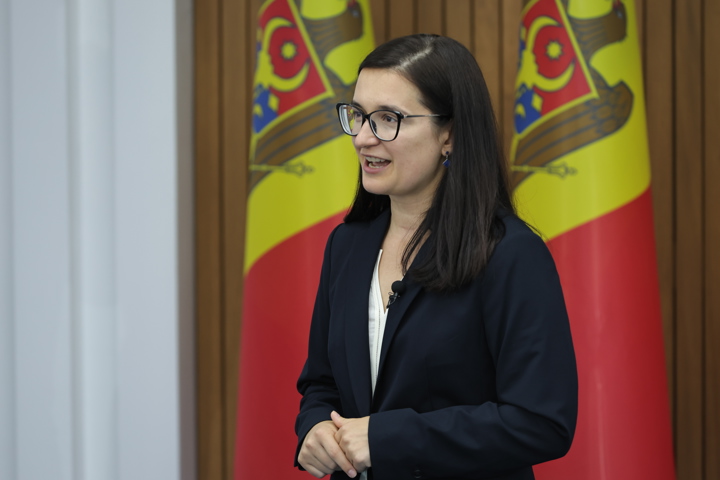
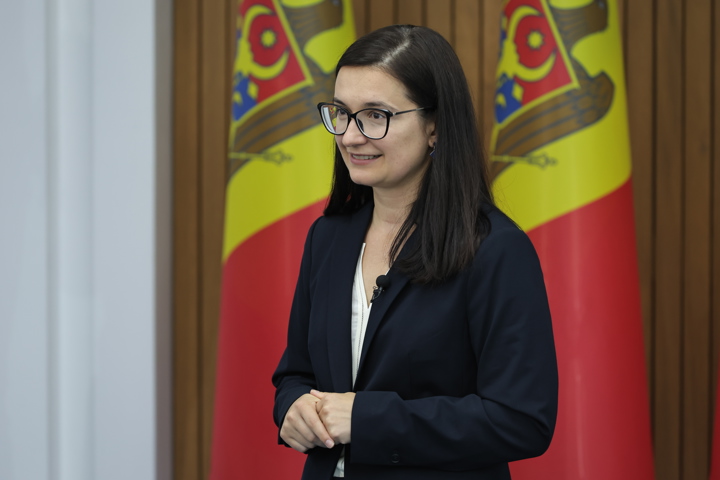
Thank you. Dear Commissioner Varhelyi, dear Marc, dear colleagues, I will say a few words in Romanian for the very start. We can also test the translation efforts of our colleagues working for us today and tomorrow.
Ziua de astăzi constituie pentru Republica Moldova o următoare etapă pe drumul nostru european de aderare la Uniunea Europeană.
Așa, încercăm să vedem dacă avem cu toții canalul care trebuie.
Ziua de astăzi constituie pentru noi începutul unei noi etape în procesul de negociere, în procesul de aderare a Republicii Moldova la Uniunea Europeană, în procesul de ancorare a țării noastre într-un spațiu al păcii, al stabilității, al prosperității și al libertății pe care ni-l dorim cu toții aici în Republica Moldova.
Faptul că am ajuns la această etapă doar în doi ani din momentul în care Republica Moldova a fost oferit statutul de țară candidată vorbește foarte mult despre eforturile pe care le-au depus echipele din cadrul Guvernului și, în general, efortul societății noastre, care reprezintă voința noastră ca țară să devenim stat membru al Uniunii Europene cu drepturi depline pe cât de curând posibil.
La fel, este și un semnal foarte clar al deschiderii Uniunii Europene, Comisiei Europene, de a ne primi ca parte a familiei Uniunii Europene, de a accelera procesul nostru de aderare la Uniunea Europeană. Este esențial pentru noi acasă să continuăm, să ne mobilizăm eforturile la maxim, în așa fel ca în următorii ani să reușim să facem cât mai multe.
Și aici etapa de screening bilateral, așa cum ați menționat dumneavoastră, domnule comisar Varhelyi, este cu adevărat piatra de căpătâi a procesului de negocieri propriu-zise. O să ne ajute acest proces să înțelegem mai bine unde suntem în procesul nostru de aderare, cât suntem de pregătiți, care sunt pașii pe care trebuie să-i parcurgem și să ne ajute să ne organizăm și de partea noastră, în Republica Moldova, și la Bruxelles, pentru următorii pași care urmează să-i implementăm, în așa fel ca să reușim să ne aliniem legislația națională la regulile și standardele Uniunii Europene.
Țin să-mi exprim recunoștința profundă pentru că ați acceptat ca această primă ședință de screening bilateral s-o găzduim la Chișinău și nu la Bruxelles. Pentru noi, din nou, este un semnal foarte puternic al Comisiei Europene, al statelor membre, că sunteți deschiși și dispuși nu doar să ne cunoașteți pe hârtie, dar și în viața reală. Ne bucurăm mult, colegii din cadrul Comisiei Europene o să poată, fiind prezenți aici timp de două zile, să ne cunoască mai bine, inclusiv cum lucrăm, cum discutăm, cum interacționăm între noi.
Asta cred că o să dea dovadă încă o dată că cetățenii Republicii Moldova sunt cu adevărat cetățeni europeni și noi ținem foarte mult la procesul nostru de aderare accelerată la Uniunea Europeană.
Now I will switch back to English.
Dear Commissioner Varhelyi, I'd like to underscore once again the importance of your presence here, the importance of colleagues from the European Commission here, just a few weeks after we held the intergovernmental conference in Luxembourg, an important historical moment for the Republic of Moldova and a very clear political signal on behalf of the EU that we have green light to continue with our homework back in Chișinău.
I think it's a recognition of Moldova's efforts that we are committed and it's also recognition of your openness to move forward. I would like to take this opportunity and express my gratitude to you personally and to your teams back in Brussels who made the intergovernmental conference possible so quickly, but also this moment possible here. We look forward to our further cooperation. Thank you.
Thank you very much, Cristina. I think after the official parts of the opening, we will dive into the detail if if you agree.
When when we dive in the process, I have the statement which I would I was waiting for the press to to go out.
Ah. Okay. So sorry. Yes.
Yeah.
I would like to thank the commissioner for his participation and